
The VCCC Alliance Model of Consumer Engagement draws upon the consumer involvement capability model of Cancer Australia and outlines five levels of consumer participation.

The Framework deepens understanding of trauma and its related concepts, offering guiding principles and outlining key domains to support trauma-informed approaches in everyday work.
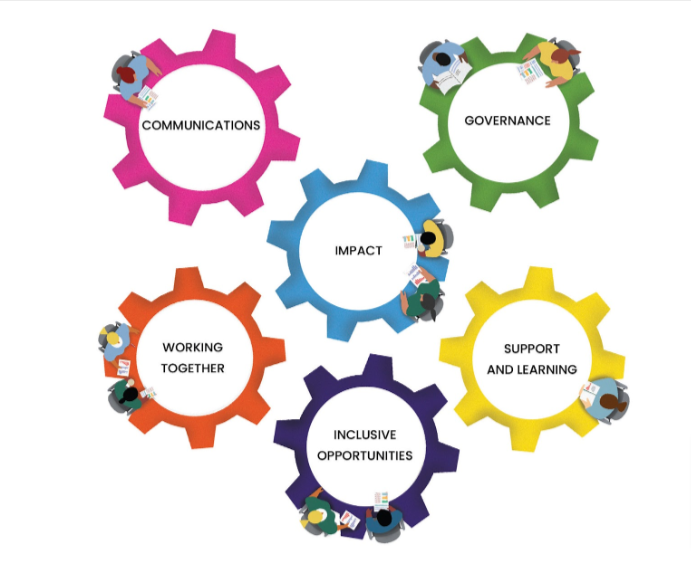
The standards provide a flexible framework for effective public involvement in research, promoting reflection, learning from both successes and failures, and supporting continuous improvement across diverse methods and contexts.
The IAP2 Spectrum of Public Participation is a widely used framework developed by the International Association for Public Participation (IAP2). The spectrum outlines five levels of participation, each reflecting increasing degrees of public influence on decision making.

The Strategy is an implementation resource to strengthen partnerships between health policy makers and the community.
Advice on best practice consumer involvement in MRFF-funded health and medical research including principles for consumer involvement and implementation advice.

The NHMRC’s Ethical Conduct in Research with Aboriginal and Torres Strait Islander Peoples and Communities (2018) provides a framework of principles that ensure research involving Aboriginal and Torres Strait Islander peoples is: safe, respectful, responsible, high quality and of benefit to the communities involved. These guidelines are designed to support researchers and stakeholders in conducting […]

The Statement aims to guide research institutions, researchers, consumers and community members in the active involvement of consumers and community members in all aspects of health and medical research. It is under review in 2025. Appendix 3 of the Statement, ‘the research cycle’, helps researchers plan and implement meaningful consumer and community involvement across all […]

Consumers can be formally employed through contracts to contribute their lived experience expertise to research, healthcare improvement, or policy development.Examples of Consumer Roles:

Consumer partnership is a collaborative approach where researchers, healthcare providers, and consumer organisations work together in a meaningful and active way to design and conduct research or healthcare improvement projects. These partnerships often involve broad collaboration between research teams and consumer organisations or groups, with one or more consumer partners helping to guide the direction […]

A co-researcher approach involves people with lived experience working as equal members of a research team, actively contributing to all stages of the project alongside academic researchers. This model embeds consumers in the research process, recognising their unique insights and expertise. To support meaningful involvement, consumer co-researchers may receive training and capacity-building to develop skills […]

Consumer advocacy is an approach where individuals with lived experience work to champion the rights, needs and priorities of the broader patient and carer community across healthcare, research and policy development. By doing so, consumer advocates can ensure that the lived experience perspective is embedded in decisions being made. Consumer advocates take on roles like […]